Here’s What You May Have gotten Wrong about the 5 Stages of Grief
Most people have heard of the Five Stages of Grief: denial, anger, bargaining, depression, and acceptance. But here is what you may find surprising…
This model, developed by psychiatrist Elisabeth Kübler-Ross in the late 1960s, was originally meant to describe the emotional process of people facing their own terminal illness and not necessarily those grieving a loss. Over time, the model became popularized (and often oversimplified) as a universal roadmap for grieving. While these stages can feel resonant for some (certainly there is much value in pondering the characteristics of each stage), they were NEVER intended to be linear or prescriptive.
As anyone who has ever grieved anything in the history of time will know, grief doesn’t follow a clear trajectory. There is no checklist. You may feel anger long before denial. You may skip over depression entirely, or loop back to it months later. You may never feel “acceptance” in the way others expect you to.
When we believe we’re supposed to grieve a certain way or be done at a certain time we often pathologize our own experience. We assume we’re doing it wrong. But, let me assure you, you’re not doing it wrong. Grief is unpredictable because love is complex, and what we lose is never just one thing (I’ll write more about secondary losses soon).
It may be tempting to hope that you could follow a “grief-cure-recipe” and go through the process in neat, orderly, forthright stages and that one day you might be 100% healed or recovered from your loss. Certainly we do hope for a relief from the acute experience of grief. But I’d like to encourage you to remember that this grief is now a part of who you are. AND it’s just that – a part. It is not the entirety of your make-up, but it is an important part. So my hope for your grief journey would be that you find hope in learning how to carry all your parts in a holistically integrated way. You can continue to grieve AND experience love, fulfillment, joy, meaning, and purpose in this wondrously imperfect life.
That being said, there are many ways we can engage with our grief. If you’re feeling stuck and like you want some guidance in how to engage with your grief in a way that makes sense (er, as much sense as something can make in the face of devastating loss), I’ve written about a few alternative grief models below. You may find it useful to know about them and experiment with processing the various elements within each framework to see what models or aspects provide the most support to you as you move forward. And don’t feel like you need to choose just one - I am in full support of mixing and matching from the various models!
The Dual Process Model
The Dual Process Model, developed by Margaret Stroebe and Henk Schut, offers a dynamic framework for understanding how people adapt to loss. Rather than describing grief as a linear progression through stages, the model emphasizes an ongoing oscillation between two orientations: loss-oriented coping and restoration-oriented coping.
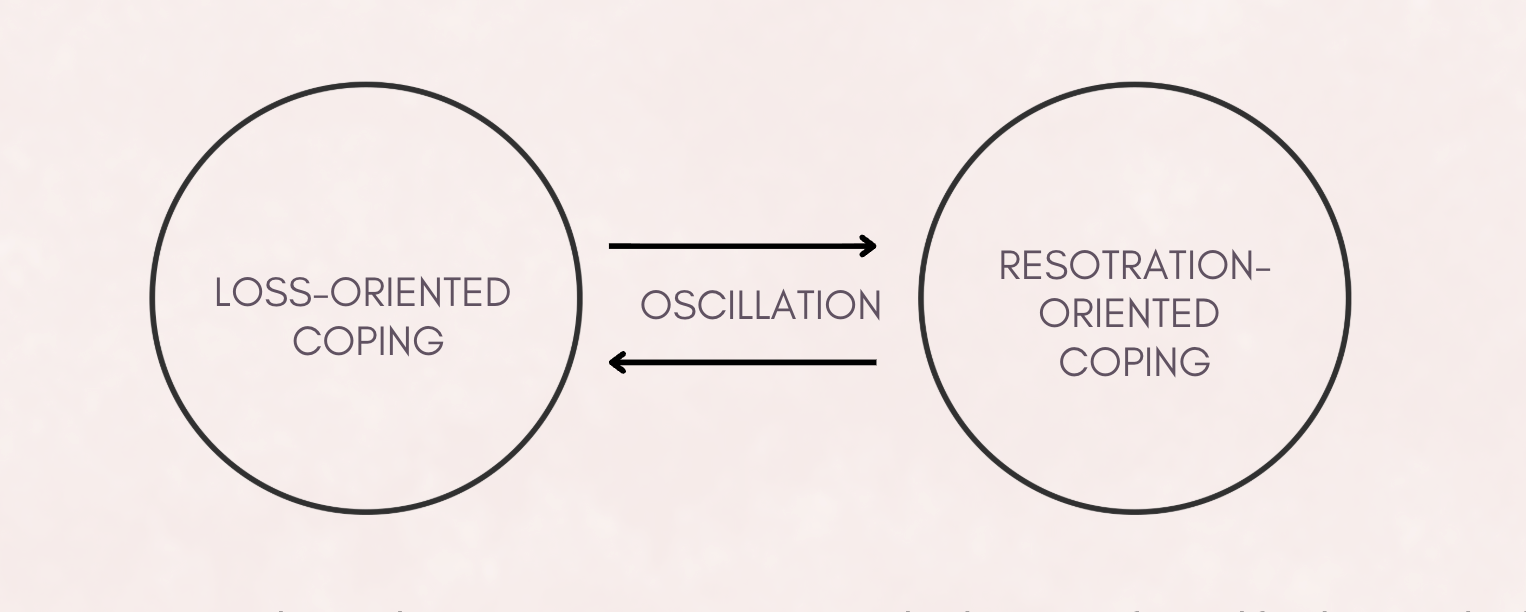
Loss-oriented coping involves direct engagement with the grief itself. This includes activities such as remembering, yearning, crying, or revisiting places and objects tied to the loss. Restoration-oriented coping, by contrast, centers on the practical and emotional adjustments required to continue living, like managing new responsibilities, cultivating new roles, and engaging in life activities that move beyond the immediate intensity of grief.
The key insight of the model lies in the movement between these two orientations. Grieving individuals shift back and forth, sometimes immersing themselves in the pain of the loss, and at other times turning toward tasks that help rebuild or sustain daily life. This oscillation allows for both acknowledgment of what has been lost and adaptation to life in a new reality in light of that loss.
By framing grief as an alternating process rather than a fixed path, the Dual Process Model highlights resilience and flexibility. It recognizes that healthy grieving involves periods of sorrow and confrontation alongside moments of reprieve, growth, and reconstruction. The balance between these two orientations is unique to each individual, and the rhythm often changes over time as circumstances and inner resources shift.
For further reading, check out the article by Strobe and Shut here.
The “Growing Around Grief” Model
Phyllis Silverman and Lois Tonkin advanced a conceptual model that challenges the notion of grief diminishing over time. Tonkin’s “Growing Around Grief” model suggests that grief often remains relatively constant in size, but as individuals continue to live, their life expands around it.
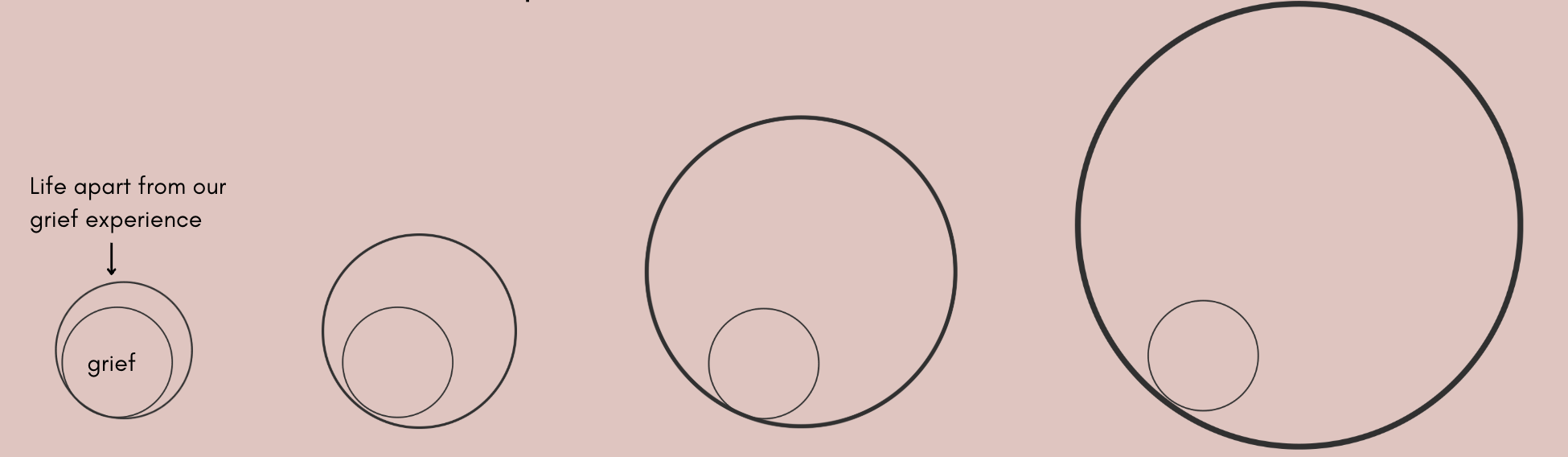
In this model, the circle of grief is surrounded by a larger and growing circle of life experiences - new relationships, skills, responsibilities, sources of meaning, and even moments of joy. The grief does not vanish or shrink; instead, it becomes one part of a broader, more expansive existence.
The strength of this model lies in its resonance with lived experience. Many people report that their grief never truly lessens, but their capacity to hold it changes as their life enlarges. This framing validates the enduring nature of grief while offering reassurance that life can continue to grow in meaningful ways around loss.
The Conscious Grieving Model
Developed by Claire Bidwell-Smith and informed by her decades of work as a grief-therapist, the Conscious Grieving Model outlines four orientations that typically follow a linear progression.
Entering into Grief: Invites the griever to allow for an awareness of their initial feelings of grief, even when those feelings encompass denial, overwhelm, and anxiety.
Engaging with Grief: Encourages the griever to stay present to their grief at a time when their instinct may be to avoid the feelings like guilt, depression, anger, and shame that occur when navigating the complicated realms of holidays and anniversaries, family and culture and multiple losses.
Surrendering to Grief: Asks the griever to rely upon spirituality, self-compassion, and resilience as a way to surrender to the changes in identity that occur within the face of loss.
Transforming through Grief: Explores ritual, honor, hope, humility, and grace to invite the griever to consider the opportunities within loss to allow for transformation and meaning.
(Borrowed from Conscious Grieving: A Transformative Approach to Healing from Loss by Claire Bidwell-Smith, 2024)
Conscious Grieving is all about embracing grief. This might seem frightening, but the alternative (suppressing the feelings of sadness following loss) usually results in a wide variety of less pleasant states of being, ie. anxiety, depression, catastrophic thinking, exhaustion, and so much more. When perceiving of grief within the Conscious Grieving model one might look for opportunities to engage with grief and to integrate it into their life thereby making room for the powerful transformation that grief offers. For further reading please check out Claire’s book Conscious Grieving: A Transformative Approach to Healing from Loss. In my opinion, it is an indispensable text for any griever. Claire is also an invaluable resource in the grief space. You can find out more about her and her work at her website https://clairebidwellsmith.com/.
Your grief doesn’t have to follow a model
If none of these models feels right to you, that’s ok. Your journey is your own. The fact that you have read this far tells me you feel some agency within your experience - and that’s a good thing. You didn’t ask to experience your loss, yet I see and recognize the strength and determination within you to move forward and make a meaningful life despite the absence of someone or something very important to you. Your journey will not look like anyone else’s, nor should it. The models simply provide various grounding points should you choose to use them. If you’d like to learn more about how to tend to your grief in a way that’s uniquely your own, please check out my Grief Tending Course which provides further support in the form of education, rituals, journaling prompts and visualizations to accompany you on your way. Much love to you, my dear Griever. xxx